what does it mean to have a low opportunity cost
In microeconomic theory, the opportunity cost of a detail activeness option is the loss of value or do good that would be incurred (the price) past engaging in that activeness, relative to engaging in an alternative activity offering a college render in value or benefit.
In basic equation form, opportunity cost can exist divers as:
- Opportunity Cost = (returns on all-time Forgone Pick) - (returns on Chosen Option)[1]
Straight or indirectly, opportunity price underpins the majority of day-to-mean solar day economic decisions that are fabricated in club.[ citation needed ] [ dubious ] For example, the opportunity price of mowing one'due south own lawn for a doctor or a lawyer (who might otherwise make $100 an hour if they elected to work overtime during that fourth dimension instead) would exist higher than for a minimum-wage employee (who in the United States might earn $vii.25 an hour), which would make the former more probable to hire someone else to mow their backyard for them.
As a representation of the human relationship between scarcity and option,[2] the objective of opportunity cost is to ensure efficient use of scarce resources.[3] Information technology incorporates all associated costs of a decision, both explicit and implicit.[4] Opportunity price also includes the utility or economic benefit an individual lost, if it is indeed more than than the monetary payment or actions taken. As an example, to go for a walk may not have any financial costs imbedded in to it. Yet, the opportunity forgone is the time spent walking which could take been used instead for other purposes such as earning an income.[iii]
However, fourth dimension spent chasing after an income might have wellness problems like in presenteeism where instead of taking a sick mean solar day ane avoids information technology for a salary or to be seen as being active.
A production possibility borderland shows the maximum combination of factors that can exist produced. For example, if services were on the 10-centrality of a graph and in that location were to be an increase in services from xx to 25, this would lead to an opportunity cost for the goods that are on the y axis, as they would driblet from 21 to 16. This means that as a result of the increase in consumption of services, the opportunity price would exist those 5 goods that have decreased.[5]
Regardless of the time of occurrence of an action, if scarcity was non-existent and then all demands of a person are satiated. It's just through scarcity that pick becomes essential, since the use of scarce resources in one mode prevents its use in another manner, resulting in the need to brand a selection and/or decision.[ii]
Sacrifice is a given measurement in opportunity cost of which the conclusion maker forgoes the opportunity of the next best culling.[6] In other words, to disregard the equivalent utility of the all-time alternative selection to proceeds the utility of the best perceived choice.[7] If there are decisions to be made that require no cede so these are cost free decisions with zero opportunity cost.[eight] Through the analysis of opportunity cost, a company can cull a path where the actual benefits are greater than the opportunity toll, so that limited resource can exist optimally allocated to attain maximum efficiency.
Types of opportunity costs [edit]
Explicit costs [edit]
Explicit costs are the direct costs of an action (business concern operating costs or expenses), executed either through a greenbacks transaction or a physical transfer of resources.[4] In other words, explicit opportunity costs are the out-of-pocket costs of a firm, that are hands identifiable.[9] This means explicit costs will always have a dollar value and involve a transfer of money, e.one thousand. paying employees.[ten] With this said, these detail costs can hands exist identified under the expenses of a house's income argument and balance sheet to represent all the cash outflows of a house.[11] [10]
Examples are every bit follows:[9] [12]
- Land and infrastructure costs
- Operation and maintenance costs—wages, rent, overhead, materials
Scenarios are every bit follows:[11]
- If a person leaves work for an hr and spends $200 on office supplies, and so the explicit costs for the private equates to the total expenses for the part supplies of $200.
- If a printer of a company malfunctions, then the explicit costs for the company equates to the total amount to be paid to the repair technician.
Implicit costs [edit]
Implicit costs (too referred to as implied, imputed or notional costs) are the opportunity costs of utilising resources endemic past the firm that could be used for other purposes. These costs are frequently hidden to the naked heart and aren't made known.[12] Unlike explicit costs, implicit opportunity costs correspond to intangibles. Hence, they cannot exist conspicuously identified, divers or reported.[eleven] This means that they are costs that have already occurred within a project, without exchanging greenbacks.[13] This could include a small business owner non taking whatever salary in the beginning of their tenure as a fashion for the business to exist more than profitable. As implicit costs are the result of assets, they are also not recorded for the use of accounting purposes because they exercise not stand for any monetary losses or gains.[thirteen] In terms of factors of production, implicit opportunity costs allow for depreciation of goods, materials and equipment that ensure the operations of a visitor.[xiv]
Examples of implicit costs regarding production are mainly resource contributed past a business concern owner which includes:[9] [14]
- Homo labour
- Infrastructure
- Time
Scenarios are every bit follows:[xi]
- If a person leaves work for an hr to spend $200 on office supplies, and has an hourly charge per unit of $25, then the implicit costs for the individual equates to the $25 that he/she could have earned instead.
- If a printer of a company malfunctions, the implicit cost equates to the total product time that could have been utilized if the machine did not break down.
Excluded from opportunity cost [edit]
Sunk costs [edit]
Sunk costs (too referred to as historical costs) are costs that accept been incurred already and cannot be recovered. As sunk costs have already been incurred, they remain unchanged and should not influence present or hereafter deportment or decisions regarding benefits and costs.[15] Conclusion makers who recognise the insignificance of sunk costs then understand that the "consequences of choices cannot influence selection itself".[ii]
From the traceability source of costs, sunk costs can exist straight costs or indirect costs. If the sunk toll can be summarized every bit a single component, it is a directly cost; if information technology is caused by several products or departments, information technology is an indirect cost.
Analyzing from the limerick of costs, sunk costs can be either fixed costs or variable costs. When a visitor abandons a certain component or stops processing a sure product, the sunk cost usually includes fixed costs such as rent for equipment and wages, but it besides includes variable costs due to changes in fourth dimension or materials. Ordinarily, stock-still costs are more likely to constitute sunk costs.
Generally speaking, the stronger the liquidity, versatility, and compatibility of the nugget, the less its sunk cost will be.
A scenario is given below:[16]
A company used $5,000 for marketing and advertizement on its music streaming service to increase exposure to the target market and potential consumers. In the end, the campaign proved unsuccessful. The sunk cost for the company equates to the $v,000 that was spent on the market and advertising means. This expense is to be ignored by the visitor in its future decisions and highlights that no boosted investment should be made.
Despite the fact that sunk costs should exist ignored when making hereafter decisions, people sometimes make the fault of thinking sunk toll matters. This is sunk cost fallacy.
Non-monetary price [edit]
Seeking a certain profit might have implicit costs such as health, ecological, or other costs. Many of those costs may not exist paid directly or immediately subsequently; they may also not be paid by those responsible for the costs. For example, if a company pollutes, the company's accountants may not exist responsible for the costs, but the costs may exist externalized onto other people in the case of local pollution, or the entire population, in the case of global warming.
Smoking may personally accept higher straight costs, such as health costs; it may as well generate direct losses economically or increase the prevalence of health problems that could harm the economy. The tobacco industry generates losses for many sectors, nonetheless, for the tobacco industry no cost may exist paid. Quitting smoking may reduce hidden costs—choosing to take a walk instead of smoking could be beneficial to one's health, for example. Choosing to piece of work one-half-fourth dimension may allow for more residuum for a sick person.
Externalities are a kind of price generated from one economic agent to another. For example, the restaurant sector may exist growing but obesity may generate a toll, monetary or otherwise in many domains, such as an increased difficulty in recruiting fit firefighters. Some sectors are growing extensively from such costs, individual or non. Dentists are needed partly considering both sugary foods and tobacco generate work and need.
Plane travel may generate externalities by contributing to global warming and air pollution, which harms many sectors such as agriculture and nature tourism. Short-term profit may atomic number 82 to high costs later. Refusing to invest in infrastructure or maintenance for a visitor may lead to a loss of customers.
The development of tourism has driven the local consumption manufacture and a series of related economical growths. At the same fourth dimension, information technology can lead to excessive development and utilization of tourism resources, serious ecology damage, and a big number of negative impacts affecting the lives of local people. Overcrowding on holidays may lead to a poor experience and a loss of tourists.
Utilise in economics [edit]
Economic profit versus accounting turn a profit [edit]
Opportunity costs are typically associated with 'economic turn a profit' as opposed to 'bookkeeping profit', in which information technology is seldom considered. Although being quite similar, both types of profit have different principles and objectives in mind, the key departure being the opportunity price.
Accounting profits are the 'real costs' (in terms of real monetary value) of businesses that are included on balance sheets, cash flow statements, and income statements just exercise non include implicit costs that opportunity costs take into account.[ commendation needed ] The chief objective of accounting profits is to give an account of a visitor'south fiscal performance, typically reported on in quarters and annually. As such, bookkeeping principles focus on tangible and measurable factors associated with operating a business such as wages and rent, and thus, do not "…infer anything virtually relative economical profitability."[17] Opportunity costs are not considered in accounting profits every bit they take no purpose in this regard.
The purpose of calculating economical profits (and thus, opportunity costs) is to aid in ameliorate business determination-making through the inclusion of opportunity costs. In this fashion, a business tin can evaluate whether its conclusion and the allotment of its resources is cost-constructive or non and whether resource should be reallocated.[eighteen] Nevertheless, economic profits are non used to explicitly report real monetary proceeds. Equally such, it is more aligned with cost-do good analysis and its applications in determining business decisions and weighing potential investments (e.chiliad. Why a house would cull to invest in Project A over Project B). When making a cost-benefit analysis, concern should make its conclusion based on if it makes a positive economical profit, which suggests that the payoff of the called option is better than the opportunity cost (the adjacent best alternative).

Simplified instance of comparing economic profit vs bookkeeping profit
The calculation behind both economic and bookkeeping profits can be distinguished in a highly simplified fashion equally follows:[ citation needed ]
- Opportunity cost = Explicit Cost + Implicit Cost
- Economic profit = Income - Opportunity Cost
- Bookkeeping profit = Income - Explicit Costs
It is important to annotation that economic profit does not indicate whether or not a business decision will make coin. It signifies if it is prudent to undertake a specific determination against the opportunity of undertaking a different determination. As shown in the simplified example in the image, choosing to kickoff a business would provide $ten,000 in terms of accounting profits. However, the decision to start a business would provide -$xxx,000 in terms of economic profits, indicating that the determination to start a business organization may not exist prudent as the opportunity costs outweigh the profit from starting a concern. In this case, where the acquirement is not plenty to cover the opportunity costs, the chosen option may not be the best course of activity.[19] When economic profit is zero, all the explicit and implicit costs (opportunity costs) are covered past the total revenue and there is no incentive for reallocation of the resources. This condition is known equally normal profit.
Several performance measures of economic profit have been derived to further amend business decision-making such as risk-adjusted render on capital (RAROC) and economic value added (EVA), which directly include a quantified opportunity cost to assist businesses in risk direction and optimal allocation of resources.[20] Opportunity cost, every bit such, is an economical concept in economic theory which is used to maximise value through ameliorate decision-making.
Comparative reward versus absolute advantage [edit]
When a nation, organisation or individual tin produce a product or service at a relatively lower opportunity cost compared to its competitors, it is said to accept a comparative advantage. In other words, a state has comparative advantage if information technology gives upwards less of a resource to brand the aforementioned number of products as the other state that has to give up more.[21]
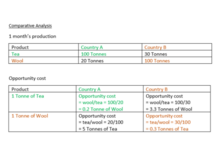
A simple example of comparative advantage.
Using the simple example in the image, to make 100 tonnes of tea, State A has to surrender the production of twenty tonnes of wool which means for every ane tonne of tea produced, 0.two tonne of wool has to be forgone. Meanwhile, to make 30 tonnes of tea, Country B needs to sacrifice the product of 100 tonnes of wool, so for each tonne of tea, 3.three tonnes of wool is forgone. In this instance, Country A has a comparative advantage over Country B for the product of tea because it has a lower opportunity cost. On the other hand, to make 1 tonne of wool, Country A has to surrender 5 tonnes of tea, while Country B would demand to surrender 0.3 tonnes of tea, and so Country B has a comparative reward over the production of wool.
Absolute reward on the other hand refers to how efficiently a political party can use its resources to produce goods and services compared to others, regardless of its opportunity costs. For example, if Country A can produce i tonne of wool using less manpower compared to Country B, and so it is more efficient and has an absolute advantage over wool production, even if it does non have a comparative reward because it has a higher opportunity cost (5 tonnes of tea).[21]
Absolute advantage refers to how efficiently resource are used whereas comparative advantage refers to how petty is sacrificed in terms of opportunity cost. When a country produces what information technology has the comparative advantage of, fifty-fifty if it does not have an absolute reward, and trades for those products information technology does non have a comparative advantage over, it maximises its output since the opportunity cost of its product is lower than its competitors. Past focusing on specialising this way, information technology also maximises its level of consumption.[21]
Opportunity cost at governmental level [edit]
Much like individual decisions, it is oft the case that governments must consider opportunity toll when enacting legislation. Taking universal basic healthcare as an example, the opportunity cost at the government level is quite clear. Assume that implementing basic healthcare would cost a authorities $1 billion: the explicit opportunity cost to implement such legislation would be a combined $one billion that could have been spent on education, housing, transport infrastructure, environmental protection, or military defense, for example. For this particular scenario, the implicit toll is quite minimal. Merely the cost of producing such legislation through man labour and the time of product would demand to be accounted for.
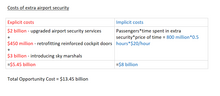
Opportunity cost to implement additional hijacking prevention methods
While the previous situation'south implicit cost may have been somewhat negligible at a regime level, this is not true for all scenarios. Using hijacking prevention methods following the September 11 attacks as an example, the boosted brunt of implicit costs is evident. To implement more sophisticated airdrome security systems, the The states authorities estimated the cost to be around $ii billion. An additional $450 million would be spent to reinforce plane doors, forth with an extra $3 billion spent on sky marshals for all American flights to help further prevent future hijackings from taking identify. Nether this scenario, the explicit cost would be $five.45 billion. Implicit costs, however, would far outweigh this. The US government has calculated that by waiting an additional xxx minutes due to actress drome security, multiplied by an boilerplate of 800 million passengers per year with the average price of time at $20 per hr, the total implicit toll to the US economy from such prevention methods would be upwards of $8 billion.[22] Thus the importance of recognising the opportunity toll at a governmental level is crucial in efficiently allocating authorities funds.
Come across also [edit]
- Austrian School
- Best alternative to a negotiated agreement
- Budget constraint
- Economical value added
- Fear of missing out
- Lucrum cessans
- Opportunity price of majuscule
- Product-possibility frontier
- Reduced cost aka 'opportunity price' in linear programming
- There ain't no such thing every bit a gratuitous lunch
- Fourth dimension management
- Merchandise-off
- You lot tin can't take your cake and eat it
- Perverse subsidies
References [edit]
- ^ Fernando, Jason. "Opportunity Price". Investopedia . Retrieved 23 Apr 2021.
- ^ a b c Buchanan, James 1000. (1991). "Opportunity Cost". The World of Economics. The New Palgrave: 520–525. doi:10.1007/978-ane-349-21315-3_69. ISBN978-0-333-55177-half dozen – via SpringerLink.
- ^ a b "Economics A-Z terms beginning with O". The Economist . Retrieved 1 November 2020.
- ^ a b Hutchison, Emma (2017). Principles of Microeconomics. Academy of Victoria.
- ^ Pettinger, Tejvan. "Opportunity Cost Definition". Economic science Assist . Retrieved xxx Apr 2021.
- ^ Parkin, Michael (2016). "Opportunity Cost: A reexamination". The Journal of Economical Didactics. 47 (i): 12–22. doi:x.1080/00220485.2015.1106361. S2CID 155746220 – via Taylor & Francis Online.
- ^ "A HISTORICAL VIEW OVER THE OPPORTUNITY Toll -Bookkeeping DIMENSION". ResearchGate . Retrieved 1 Nov 2020.
- ^ Burch, Earl E.; Henry, William (1974). "Opportunity and Incremental Toll: Endeavor to Define in Systems Terms: A Comment. The Accounting Review". The Accounting Review. 49: 118–123. JSTOR 244804 – via JSTOR.
- ^ a b c "Explicit and implicit costs and bookkeeping and economic profit". Khan Academy. 2016. Retrieved 1 November 2020.
- ^ a b "Explicit Costs - Overview, Types of Profit, Examples". Corporate Finance Plant . Retrieved 30 Apr 2021.
- ^ a b c d "Explicit Costs: Definition and Examples". Indeed. 5 Feb 2020. Retrieved one Nov 2020.
- ^ a b Crompton, John L.; Howard, Dennis R. (2013). "Costs: The Rest of the Economic Touch Story" (PDF). Journal of Sport Direction. 27 (5): 379–392. doi:10.1123/JSM.27.5.379. S2CID 13821685. Archived from the original (PDF) on 4 March 2019.
- ^ a b Kenton, Will. "How Implicit Costs Work". Investopedia . Retrieved 30 Apr 2021.
- ^ a b "Reading: Explicit and Implicit Costs". Lumen Learning . Retrieved one November 2020.
- ^ Devine, Kevin; O Clock, Priscilla (March 1995). "The effect on sunk costs and opportunity costs on a subjective majuscule resource allotment decision". The Mid-Atlantic Journal of Business concern. 31 (ane): 25–38.
- ^ "Four Examples of Sunk Toll". Indeed. 6 October 2020. Retrieved 1 November 2020.
- ^ Holian, Matthew; Reza, Ali (19 July 2010). "House and industry effects in accounting versus economic turn a profit data". Practical Economic science Letters. 18 (6): 527–529. doi:10.1080/13504851003761756. S2CID 154558882.
- ^ Goolsbee, Austan; Levitt, Steven; Syverson, Chad (2019). Microeconomics (tertiary ed.). Macmillan Learning. pp. 8a–8j. ISBN9781319306793.
- ^ Layton, Allan; Robinson, Tim; B. Tucker 3, Irvin (2015). Economics for Today (5th ed.). Cengage Australia. pp. 131–132, 479–486. ISBN9780170276313.
- ^ Kimball, Ralph (1998). "Economic Profit and Performance Measurement in Cyberbanking". New England Economical Review. Federal Reserve Bank of Boston: 35–39. ISSN 0028-4726. Retrieved xiii March 2021.
- ^ a b c Layton, Allan; Robinson, Tim; B. Tucker III; Irvin (2015). Economics for Today (5th ed.). Cengage Australia. pp. 131–132, 479–486. ISBN9780170276313.
- ^ Jones, Peter. "The Concept of Opportunity Cost". ER services . Retrieved 25 Apr 2021.
External links [edit]
- The Opportunity Cost of Economics Education by Robert H. Frank
Source: https://en.wikipedia.org/wiki/Opportunity_cost
0 Response to "what does it mean to have a low opportunity cost"
Post a Comment